The Fascinating History of Corn: From Ancient Grain to Modern Marvel

Jane Cornfield
The Fascinating History of Corn: From Ancient Grain to Modern Marvel
Corn is so embedded in modern life that most people never think about where it came from. It is in our fuel tanks, our sodas, our livestock feed, our building materials, and of course on our dinner plates. But the story of how a scraggly wild grass became the most produced crop on earth is one of the most fascinating chapters in human history.
Teosinte: The Unlikely Ancestor
If you placed an ear of modern corn next to its wild ancestor, you would never guess they were related. Teosinte is a grass native to the Balsas River valley in southwestern Mexico. Its seed head is about two inches long, with five to twelve hard, triangular seeds encased in a stony shell. There is no cob, no husk, no rows of plump kernels. It looks more like a sprig of wheat than anything resembling corn.
Genetic research has shown that the transformation from teosinte to maize involved changes in just five key genetic regions. But those small genetic changes produced enormous physical differences. It took Indigenous farmers roughly a thousand years of selective breeding to develop something recognizable as corn -- plants with larger ears, softer kernels, and seeds that stayed attached to the cob rather than scattering on the wind.
The Spread Across the Americas
By roughly 4000 BCE, early forms of maize had spread north and south from Mexico. Archaeological evidence shows corn cultivation in Panama by 5600 BCE and in coastal Peru by 4700 BCE. It reached the American Southwest around 2100 BCE and the eastern woodlands of North America by about 200 CE.
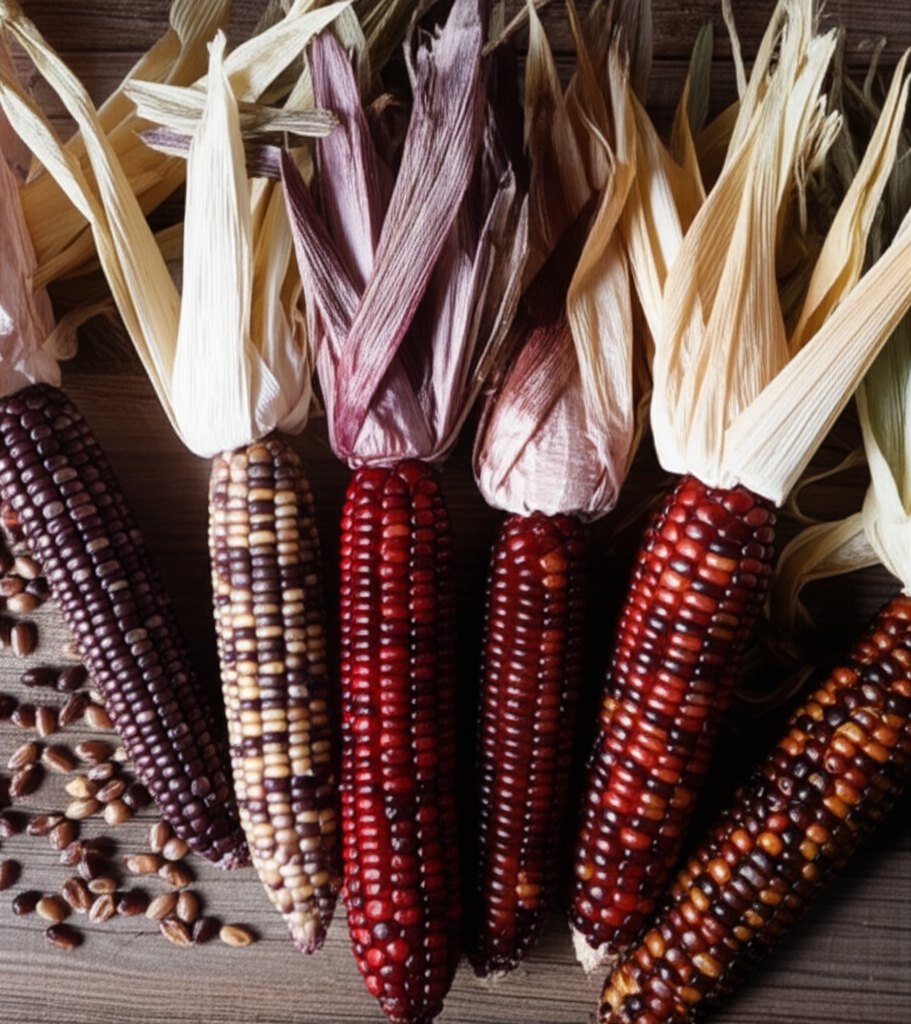
Each region's farmers adapted corn to their specific conditions. In the humid tropics, they developed varieties resistant to fungal diseases. In the arid Southwest, they bred deep-rooted varieties that could survive on minimal rainfall. In the short-season North, they selected for early-maturing plants. This process created extraordinary diversity -- by the time Europeans arrived, there were hundreds of distinct land races across the Americas.
Corn and Civilization
Corn was not just a crop -- it was the foundation of civilization in the Americas. The Maya, Aztec, and Inca empires were all built on corn agriculture. The Popol Vuh, the Maya creation story, describes humans as being literally made from corn. In Aztec society, corn was so central that their word for it, "tlaolli," also meant "our sustenance" or "our flesh."
The development of nixtamalization -- soaking corn in an alkaline solution of water and wood ash or lime -- was a crucial breakthrough. This process softened the kernels for grinding, but more importantly, it released niacin (vitamin B3) that is otherwise locked in the corn and unavailable to human digestion. Cultures that adopted corn without nixtamalization, including parts of Europe and the American South, suffered from pellagra, a devastating niacin deficiency disease.
The Columbian Exchange
When Columbus encountered corn in the Caribbean in 1492, he brought seeds back to Spain. Within a generation, corn was being grown across southern Europe. Portuguese traders carried it to Africa, where it became a staple from West Africa to Mozambique. It reached China and Southeast Asia by the 1550s.
Corn's ability to grow in diverse climates and produce high yields made it incredibly attractive to farmers worldwide. But its global spread also had consequences. In many places, it displaced more nutritionally complete local crops, and without the knowledge of nixtamalization, populations that relied heavily on corn suffered nutritional deficiencies.
The Hybrid Revolution
The twentieth century transformed corn agriculture through hybridization. In the 1920s and 1930s, researchers discovered that crossing two inbred corn lines produced offspring with dramatically higher yields than either parent -- a phenomenon called hybrid vigor. This discovery launched the modern seed industry. Farmers who had always saved their own seeds now bought new hybrid seed each year from companies.
Yields skyrocketed. In 1920, the average U.S. corn yield was about twenty bushels per acre. Today it exceeds 175 bushels per acre. But this productivity came at the cost of genetic diversity. Thousands of open-pollinated varieties were abandoned in favor of a handful of high-yielding hybrids.
Corn Today
The United States alone produces over 380 million metric tons of corn annually, making it the world's largest producer. But only a small fraction is eaten directly by humans. Roughly forty percent goes to ethanol production, thirty-six percent to animal feed, and the rest to processed food ingredients, industrial uses, and exports.
This industrial monoculture has real environmental costs: heavy fertilizer and pesticide use, soil depletion, and water pollution from agricultural runoff. Understanding the full history of corn -- its incredible diversity, its cultural significance, its transformation by human hands over millennia -- can help us think more thoughtfully about how we grow and use this remarkable plant going forward.
The ear of corn on your plate is not just food. It is nine thousand years of human ingenuity, cultural exchange, and agricultural innovation. That is worth appreciating.
Jane Cornfield
Head of Content
Jane has been writing about sustainable agriculture for over 10 years.