From Farm to Table: The Story of Heirloom Corn Varieties
Tom Kernel
From Farm to Table: The Story of Heirloom Corn Varieties
Walk through any modern grocery store and you will see one kind of corn: yellow, uniform, wrapped in plastic. But this is a tiny sliver of what corn actually is. For thousands of years, corn has come in nearly every color of the rainbow, in hundreds of shapes and sizes, each variety carrying the story of the people who grew it. The world of heirloom corn is vast, vibrant, and deeply tied to human history.
The Ancient Origins
Corn -- or maize, as most of the world calls it -- began as a wild grass called teosinte in southern Mexico roughly nine thousand years ago. Teosinte looks almost nothing like modern corn. Its "ears" are barely an inch long with just a handful of hard seeds. Through centuries of careful selection by Indigenous farmers, teosinte was gradually transformed into the crop we recognize today. This is one of the most remarkable feats of plant breeding in human history, accomplished entirely without modern science.
By the time European colonizers arrived in the Americas, Indigenous peoples had developed hundreds of distinct corn varieties, each adapted to specific climates, soils, altitudes, and uses. The Hopi grew corn in the arid desert Southwest by planting seeds a foot deep to reach residual moisture. The Iroquois grew varieties suited to the short summers of upstate New York. Andean farmers cultivated corn at elevations above ten thousand feet.
A Rainbow of Colors
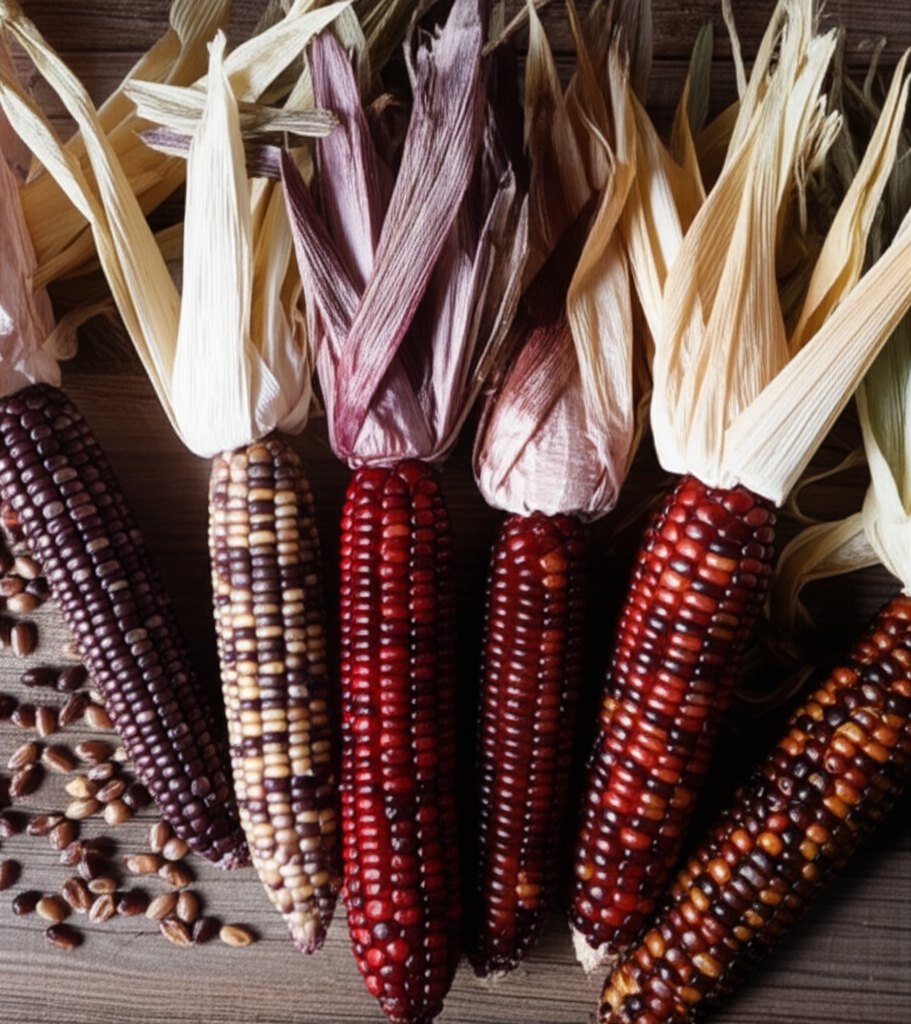
Modern shoppers might be surprised to learn that corn naturally comes in white, yellow, red, orange, pink, purple, blue, black, and even calico patterns with multiple colors on a single ear. These colors come from anthocyanins and carotenoids -- the same pigments that give blueberries and carrots their hues.
Some notable heirloom varieties include:
**Glass Gem Corn**: Perhaps the most visually striking corn on earth, with translucent kernels in every color imaginable. It was developed by Carl Barnes, a part-Cherokee farmer in Oklahoma who spent years crossing and selecting Native American corn varieties to preserve their genetics.
**Oaxacan Green Dent**: A beautiful jade-green corn from southern Mexico, traditionally used to make green-tinted tamales and tortillas with a distinctive, slightly sweet flavor.
**Bloody Butcher**: A deep crimson corn dating back to at least the 1840s in Virginia. It makes stunning red cornmeal and grits with a rich, complex flavor.
**Bear Island Flint**: A rare Abenaki variety from northern Vermont with orange and yellow kernels. It is one of the northernmost-adapted corns, maturing in just seventy days.
**Blue Hopi**: A staple of Hopi agriculture for centuries, this steel-blue corn is ground into flour for piki bread, a paper-thin traditional food. It is remarkably drought-tolerant and can grow with as little as six inches of rain per year.
Why Heirloom Varieties Matter
The push toward industrial agriculture in the twentieth century dramatically narrowed corn diversity. Today, the vast majority of corn grown in the United States is one of a handful of hybrid yellow dent varieties, bred primarily for animal feed, ethanol, and processed food ingredients like high-fructose corn syrup.
This matters for several reasons:
**Genetic diversity is insurance.** A disease or pest that can wipe out one variety may not affect another. The Irish Potato Famine happened in part because Ireland relied on a single potato variety. Maintaining a wide gene pool of corn varieties protects against similar catastrophe.
**Flavor diversity is worth preserving.** Anyone who has tasted a blue corn tortilla made from freshly ground heirloom flour knows there is a world of difference between that and a mass-produced tortilla from commodity corn. Heirloom varieties offer flavors, textures, and aromas that modern hybrids simply cannot match.
**Cultural heritage is at stake.** Many heirloom varieties are tied to specific communities, ceremonies, and foodways. When a variety goes extinct, a piece of cultural history goes with it.
The Revival Movement
Fortunately, a growing movement of farmers, seed savers, and food enthusiasts is working to preserve and revive heirloom corn. Organizations like Native Seeds/SEARCH in Tucson, the Seed Savers Exchange in Iowa, and countless small farms are maintaining living collections of rare varieties.
Chefs are playing a role too. Restaurants focused on heritage grains are sourcing heirloom corn for tortillas, polenta, grits, and baked goods, creating market demand that encourages farmers to grow these old varieties.
At CornCrate, we are proud to feature heirloom corn products in our boxes -- from blue corn tortilla chips to multicolored popcorn to heirloom cornmeal. Every time you choose an heirloom product, you are voting with your dollars for biodiversity, cultural preservation, and extraordinary flavor.
Growing Your Own Heirloom Corn
If you have garden space, consider planting an heirloom variety. Most are open-pollinated, meaning you can save seeds from year to year. Just be sure to isolate different varieties by at least two hundred feet or stagger planting times by three weeks to prevent cross-pollination. Start with a forgiving variety like Stowell's Evergreen (a white sweet corn from 1848) or Country Gentleman (a "shoepeg" corn with irregularly arranged kernels and outstanding sweetness).
The story of corn is the story of human civilization in the Americas. Every ear is a link in a chain stretching back thousands of years. Heirloom varieties keep that chain unbroken.
Tom Kernel
Sustainable Farming Expert
Tom works with small farms across America to implement sustainable farming practices.